Stop 53 of 109 · The Cross-Beat
c. 1585 · Kassel, Hesse-Kassel
The Clockmaker Who Made Two Arms Fight Each Other
In the 1580s, a Swiss clockmaker's rival escapement pushed clocks accurate enough to help chart the stars.
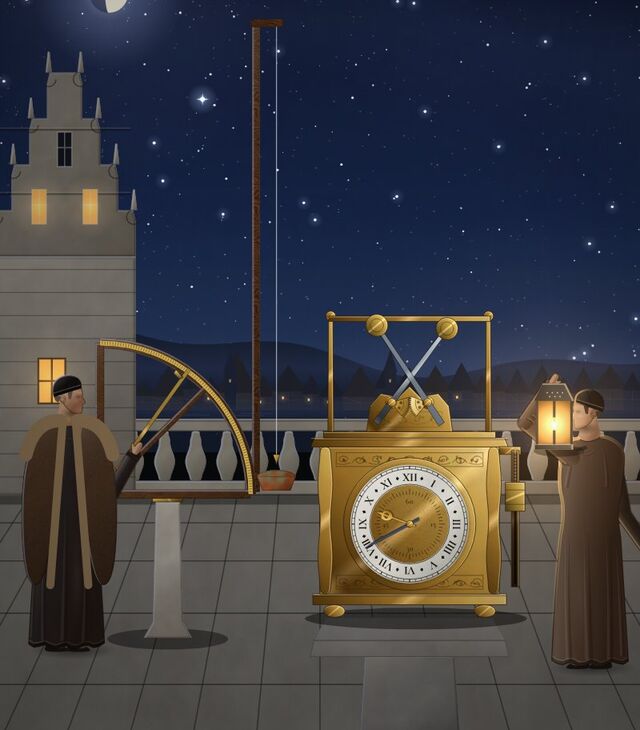
By the 1560s, Wilhelm IV, Landgrave of Hesse-Kassel, had built two observation towers onto his castle, arguably the first permanently equipped observatory in modern Europe. From 1579 he had a Swiss clockmaker, Jost Bürgi, on staff to build and repair his instruments, and from 1584 the mathematician Christoph Rothmann to help turn the observations into a new star catalogue.
The stars demanded a clock good enough to trust. Bürgi is credited with the cross-beat escapement: two arms, mounted on separate arbors and geared together, swinging against each other rather than one arm swinging alone. He paired it with a remontoire, a small weight or spring, rewound continually by the clock's main power, that delivered the escapement a steady push regardless of how much of the mainspring's force remained.
His clocks were said to keep time to within about a minute a day, against a quarter of an hour or worse for an ordinary clock of the period. That's a figure historians still repeat, though no measurement from the time survives to confirm it, and many now suspect the remontoire and Bürgi's own careful workmanship did as much for the accuracy as the cross-beat design itself.
Whatever the exact split of credit, the result mattered: clocks had finally become precise enough to time the sky. A handful of fine watches still carry a constant-force device descended from Bürgi's remontoire, keeping the push to the escapement even as the mainspring winds down.