Stop 2 of 109 · Read the Columns · 7 min read
c. 20,000 years ago · Ishango, Lake Edward
Three Columns by the Lake
A small bone from the shore of Lake Edward carries 168 notches in careful groups, and researchers have three very different guesses about what they meant.
Fact rating: SpeculativeFact rating
the 168 notches are real. the prime-number reading is the least secure of the three.
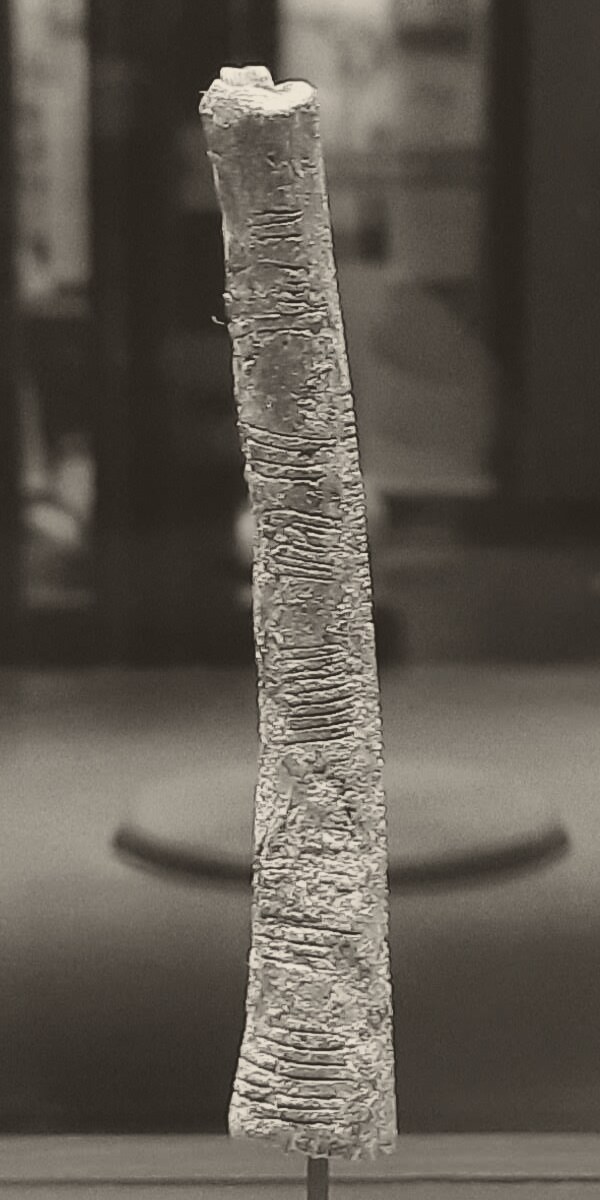
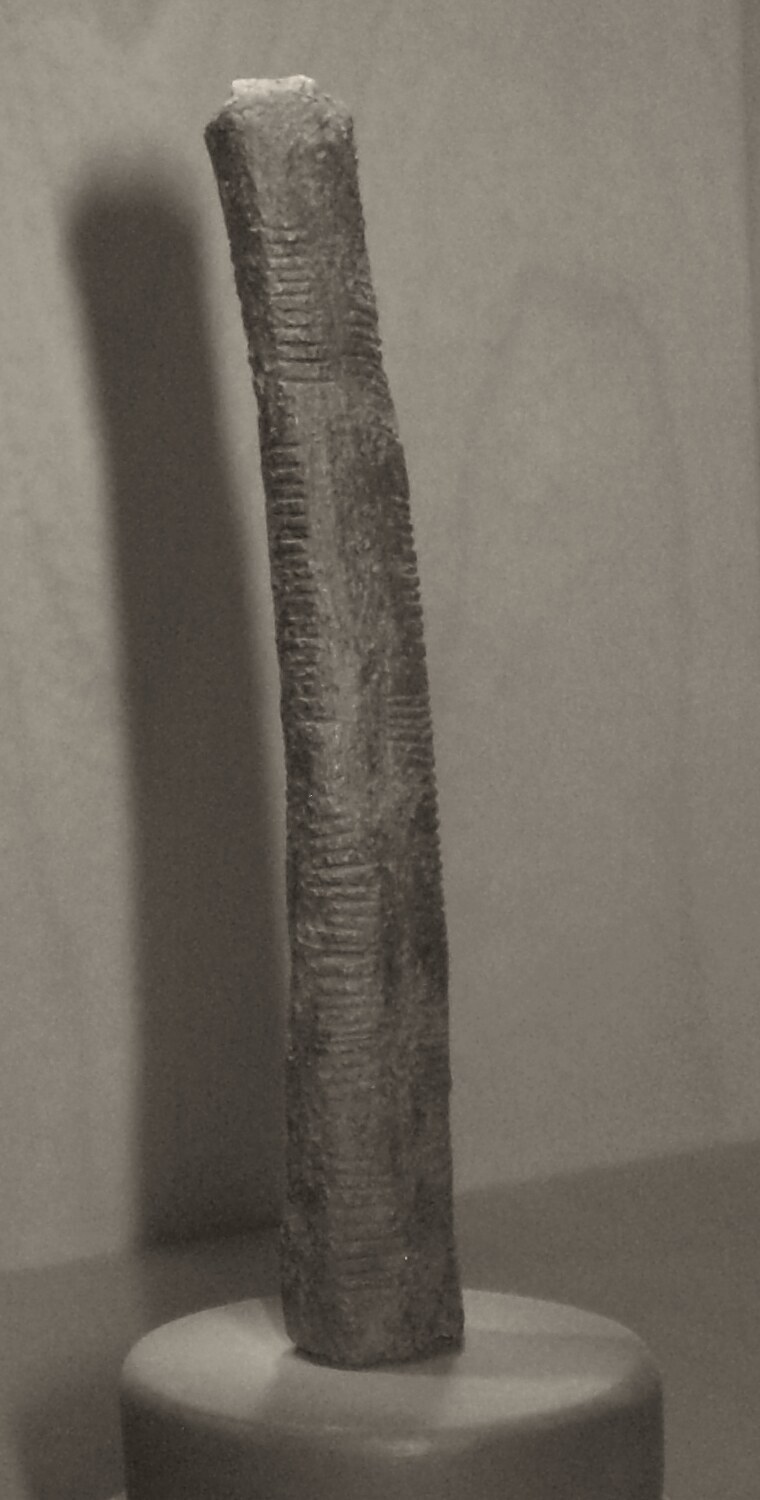
Twenty thousand years ago or more, on the shore of Lake Edward in Central Africa, someone notched a dark bone about ten centimetres long, topped with a sliver of quartz. It was found in 1950 near the fishing settlement of Ishango and now sits in the Royal Belgian Institute of Natural Sciences in Brussels.
The bone carries 168 notches, arranged in three columns, and people have been trying to read them for more than sixty years. Its finder saw arithmetic. A journalist turned prehistorian saw the Moon. Two mathematicians saw the number twelve. Each reading has its critics. Here is a longer look: the place, the object, its age, the readings and the doubts.
A fishing camp by a changing lake
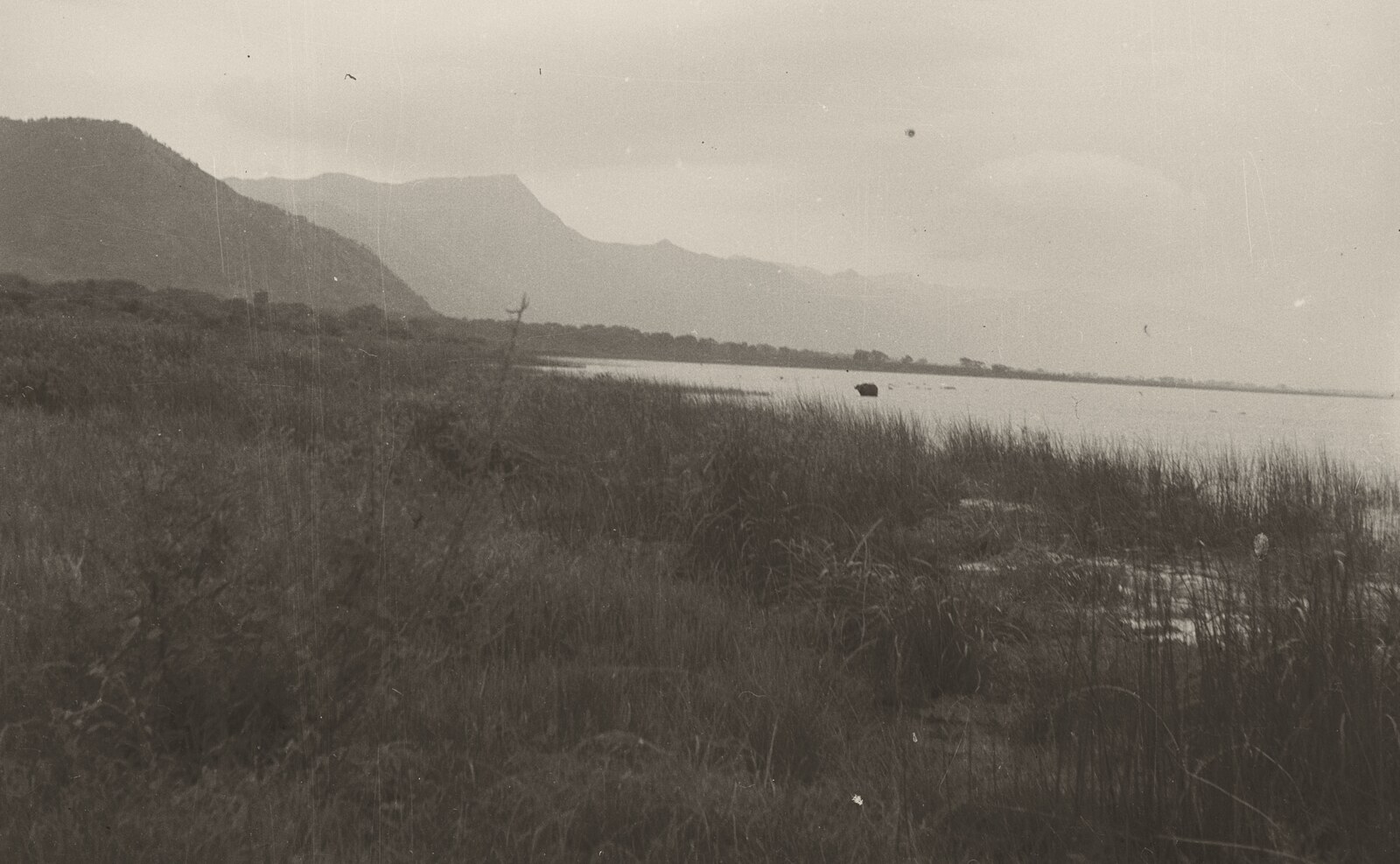
Lake Edward lies in the western branch of the Great Rift Valley, on the border between the Democratic Republic of the Congo and Uganda. It is about 77 kilometres long and sits more than 900 metres above sea level. Its water leaves to the north through the Semliki River, part of the system that feeds the White Nile. Ishango is on the Congolese shore, where the Semliki flows out of the lake, inside Virunga National Park, the oldest national park in Africa.
The site was spotted in 1935 by Hubert Damas, a zoologist from the University of Liège, who came across human bones and bone harpoon heads while digging for a survey. Jean de Heinzelin, a geologist at the Brussels institute, came to excavate it properly, in campaigns between 1950 and 1959. He cut two long trenches at right angles into the shore and drew their layers, which showed that the lake had once stood much higher.
What came out was a lakeside life. There were hundreds of barbed bone points and harpoon heads, many unfinished, so they were made on the spot. There were fish bones, and the cut-marked bones of hippopotamus, warthog, buffalo and antelope. About a hundred human bones came from at least nine people, adults, children and babies, members of our own species with a few older features. Minerals from the volcanic ash turned the bones to stone, which is why they are dark brown today, the Ishango bone among them.
A handle with a stone tip
The bone itself has been narrowed, scraped and polished so thoroughly that no one can now say which animal it came from, beyond a mammal. Some accounts call it a baboon's fibula; its museum does not. A small piece of quartz is set into the narrow end and sticks out by about two millimetres, so this was a handle with a working tip, a rare survival from so long ago. De Heinzelin thought it might have been used for engraving or tattooing; the museum suggests fine work such as ritual scarification, cutting decorative scars into skin.
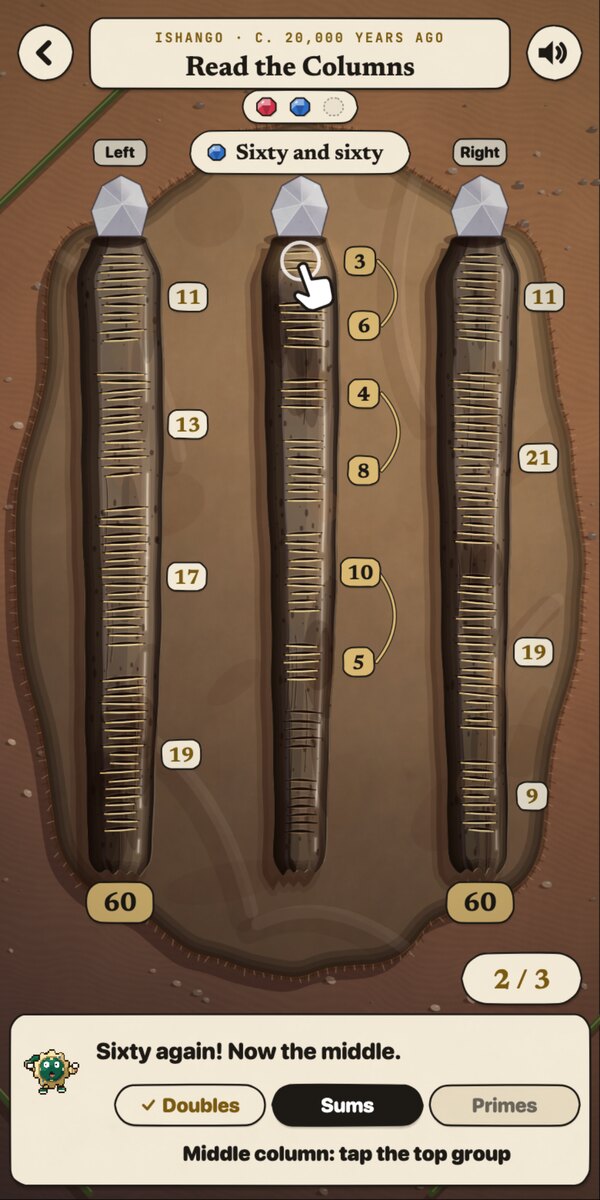
Then there are the notches: short, roughly parallel cuts in groups, running in columns along three sides of the handle. De Heinzelin labelled the columns with French letters: G for gauche, left; D for droite, right; M for milieu, middle. Column G has groups of 11, 13, 17 and 19. Column D has 11, 21, 19 and 9. Column M, along the most curved side, has eight smaller groups: 3, 6, 4, 8, 10, 5, 5 and 7. Two of the columns add up to 60 each; the third comes to 48.
Those totals depend on how you count. Part of the surface is damaged. The last notch of the group of 10 is broken in the middle and set a little apart, so the group may really be 9, and the first notch of the next group of five is faint. That is why careful accounts give 167 or 168 notches. The critic Olivier Keller adds that one of the groups of five is all but illegible. Every reading below rests on these counts.
Older than anyone first thought
The first estimates made Ishango much younger. When de Heinzelin wrote up the site for Scientific American in 1962, the village was thought to be about 11,000 years old, and figures of 8,500 to 9,000 years were repeated long afterwards. Ishango was read as part of the wet early Holocene, the warm period after the last ice age, when fishing peoples spread across eastern and northern Africa.
In the 1980s Alison Brooks of George Washington University and her colleagues took a fresh look at Ishango. In 1987 Brooks and Catherine Smith published new age determinations which suggested that this fishing way of life had begun in the late Pleistocene, before the ice age ended. The dating used radiocarbon and amino acid racemisation, a method that reads the slow changes in amino acid molecules over time. Today the layer with the human remains and the early Late Stone Age tools is dated to between about 25,000 and 20,000 years ago, around the coldest part of the last ice age.
So the bone's age is quoted variously. The museum in Brussels says nearly 20,000 years; the Smithsonian and a 2025 sourcebook on number systems say about 25,000; the UNESCO portal on astronomical heritage gives 25,000 to 16,000. All of them rest on dating the site: the bone itself has turned to stone and keeps no organic matter to date. The fairest summary is that it is at least 20,000 years old, and perhaps a few thousand more.
Arithmetic, moons or twelves
De Heinzelin was the first to read the columns as numbers. In column G he saw the four prime numbers between 10 and 20, numbers that can be divided only by themselves and one. In column D he saw 10 plus 1, 20 plus 1, 20 minus 1 and 10 minus 1, a hint of counting in tens. In column M, 3 sits close to 6, 4 close to 8, and 10 close to a pair of fives, which suggested doubling. "It is of course possible that all the patterns are fortuitous," he wrote. "But it seems probable that they were deliberately planned." Perhaps, he thought, they were an arithmetical game.
Alexander Marshack, a print and television journalist researching the history of science for a NASA project, read de Heinzelin's article and drew a different conclusion. He thought marks like these were records kept over time, and after studying the bone under a microscope he argued that it was a six-month lunar calendar, a count of the Moon's phases. The numbers fit loosely: 168 days is a little under six lunar months of 29.5 days, and 60 is close to two of them. He went on to read many other notched bones the same way.
In the 1990s two mathematicians, Dirk Huylebrouck and Vladimir Pletser, proposed a third reading. They studied the lengths and spacing of the notches in column M and found the numbers 3 and 4 doing most of the work, which pointed them to a count built on twelve, three times four. Seen that way, 11, 13, 17 and 19 become 12 minus 1, 12 plus 1, 18 minus 1 and 18 plus 1, and all three column totals, 60, 48 and 60, are multiples of 12. Their conclusion is deliberately modest: probably a tool for counting events or things, kept by someone who mixed counting in tens and twelves.
The case for caution
The prime-number reading is the least secure. Seeing primes as special needs the idea of division, and nothing else on the bone shows it; 3, 5 and 7, also primes, are not singled out. No awareness of prime numbers has been found anywhere before classical Greece, many thousands of years later. Pletser and Huylebrouck reject it, and the Brussels museum's own guide says there is not enough proof.
The sharpest critic is the mathematician Olivier Keller. Once you decide that groups of notches are numbers, he wrote in 2010, it is easy, with a few small arrangements, to make the bone talk, and even to make it say contradictory things. Column G, he showed, could just as well be 15 minus 4, 15 minus 2, 15 plus 2 and 15 plus 4. A notch may simply be a mark, he argued, and the sign itself was the great invention of the age. He called the lunar reading generally abandoned; Marshack's critics had long complained that he could find a Moon count in almost any set of marks. Pletser and Huylebrouck answered him point by point in 2016, not gently.
The newest work pulls both ways. In a 2025 sourcebook on number systems, Karenleigh Overmann agrees that the groupings seem unlikely to be chance, but notes that the marks are unbundled, long runs rather than tidy small bundles, a clumsy way to write complex ideas. Her verdict is that the evidence is inconclusive. A 2025 preprint by Jenny Baur, revised in 2026, goes the other way, claiming a web of sums and products that no random rearrangement in a million matched. But it gets there only after swapping the places of some groups and moving one notch from one group to another, and Baur herself calls the score of the bone as recorded "modest in absolute terms".
There is also a second bone. De Heinzelin found it in 1959, in the same layer as the first. It has lost its quartz, and he counted 90 notches on it, long and short, which he took as a sign of counting in sixes and tens. He never published that study, and it came out only after his death in 1998. Overmann finds its marks not mathematically interesting. Two clearly notched handles show that marking bone was not a one-off at Ishango, but not what the marks meant.
Sixty, then and now
Whatever the carver meant, one coincidence is hard to miss. Two of the three columns add up to sixty, the same sixty that still divides an hour into minutes and a minute into seconds on every watch made today. The sixty on a dial has its own long history, which this tour follows to Babylon, and no one has shown a line from Lake Edward to it.
Pletser and Huylebrouck offer one reason sixty and twelve keep turning up together. With the thumb of one hand you can count the twelve finger bones of its other four fingers, and keep track of the dozens on the other hand, up to five dozen: sixty. They suggest this is why 12 and 60 go together, even in the way we divide time. A watch dial does the same sum: twelve hour marks, five minutes apart, sixty minutes around.
Nobody knows whether the person who carved this bone ever thought in sixties, and the bone cannot tell us. What it does show is someone cutting marks in careful groups and keeping the groups apart in columns, so they could be seen and compared at a glance. A watch face still works that way.



.jpg)
