Stop 3 of 109 · Dots in the Dark
c. 17,000 years ago · Lascaux, Dordogne
The Dots Under the Stag
By lamplight, deep inside a French cave, Ice Age painters left more than animals on the wall: one researcher thinks part of it is a moon.
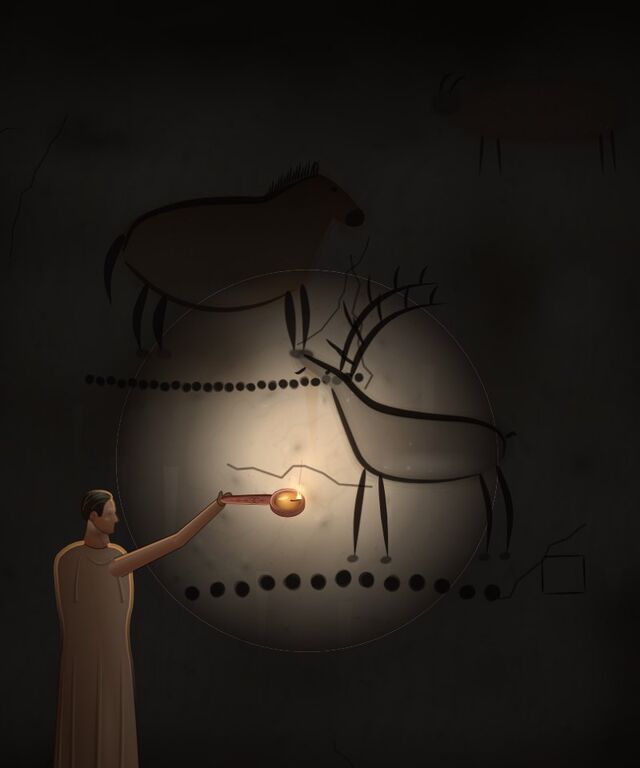
About 17,000 years ago, painters worked deep inside the cave at Lascaux in southwestern France, using small stone lamps that burned animal fat to light walls they could otherwise not see at all. One of the finest lamps found there, carved from red sandstone with an engraved handle, still survives.
By that flickering light they painted horses, cattle and stags in red and black ochre, a pigment ground from iron-rich clay and earth. Under one great stag runs a row of thirteen dots, ending in an empty square.
The researcher Michael Rappenglück has argued that the thirteen dots trace half a cycle of the moon, night by night, and that the empty square marks the dark of the new moon, the night nothing is seen at all. It is a striking idea, but far from a settled one: other researchers read similar dot rows as counts of months, or argue they may not represent time at all.
That disagreement does not erase what is actually on the wall: a row of dots, placed on purpose, beside an animal important enough to paint again and again. If Rappenglück is right, it is also the oldest known attempt to track the moon's changing face night by night, the same cycle a watch's moonphase dial still displays today on a single slowly turning disc under the crystal.