Stop 4 of 109 · Twelve Pits
c. 8000 BCE · Warren Field, Aberdeenshire
Twelve Pits and a Reset
In a Scottish field, hunter-gatherers dug a curved line of twelve pits long before farming reached Britain, and one team thinks it may be the oldest calendar on Earth.
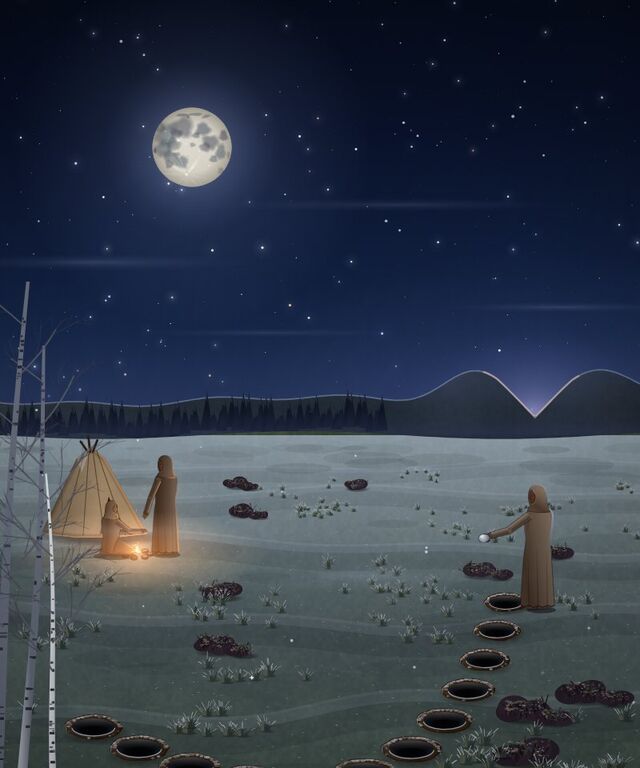
Around 8000 BCE, in what is now Aberdeenshire, Scotland, hunter-gatherers dug an arc of twelve pits stretching roughly fifty metres across a field. The site, known as Warren Field, was excavated between 2004 and 2006 and only properly understood years later.
In 2013, a team led by Vincent Gaffney proposed that the pits track the phases of the moon, one pit for each lunar month, and that the arc points toward a notch in the horizon where the sun rises at midwinter. Twelve lunar months run about eleven days shorter than a solar year, so a calendar built this way would drift out of step with the seasons unless it was corrected. The midwinter sunrise, in this reading, is that correction: a yearly reset that realigns the count.
If the idea holds, Warren Field would predate the earliest formal calendars of Mesopotamia by roughly five thousand years. That is a large claim resting on one team's analysis of a set of pits whose original purpose was never written down anywhere, so it is best held as a leading theory rather than a settled fact.
Even skeptics agree on the pits and the alignment. What remains genuinely open is whether Mesolithic Scots were tracking the moon at all, or whether a later mind is reading a calendar into an older pattern. The date the arc points to, the winter solstice, is still the one fixed anchor every solar calendar depends on: the shortest day of the year, a turning point every calendar in use today still marks.