Stop 5 of 109 · Wait for the Rains
c. 5000 BCE · Nabta Playa, Sahara
Waiting for the Rains in the Sahara
Almost seven thousand years ago, cattle herders in a wetter Sahara built a small ring of stones that still points at the sunrise of the longest day.
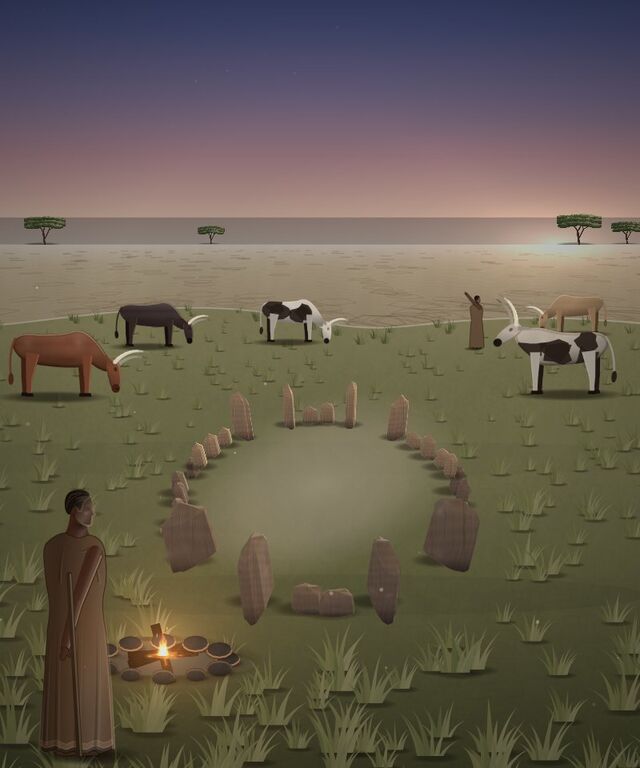
The eastern Sahara was not always desert. Around 5000 BCE, seasonal monsoon rains filled a wide basin near what is now the Egypt–Sudan border, turning it into a shallow lake each summer. Cattle herders came to that lake, and by its edge they raised a small stone circle, its slabs standing about 3.7 metres across.
The circle is built from several pairs of upright stones. Two pairs line up north to south. Another pair frames a sightline toward the horizon where the sun rises on the summer solstice, the longest day of the year, which fell close to the start of the rainy season.
For people whose herds depended on that rain arriving on schedule, a fixed marker for the solstice would have been a practical thing to have, a way of anticipating the season rather than simply waiting on it. Some researchers have proposed further stellar alignments among the site's larger standing stones, but those readings are more hypothetical, and even the team that first proposed them treats at least one alignment with real doubt.
What is well established is the age: Nabta Playa's stones were set up roughly a thousand years before the first ditch was dug at Stonehenge, making it one of the oldest deliberately aligned structures known anywhere. The solstice those herders were watching for is the same one still printed on calendars each June, the single fixed date a solar year has never drifted away from.