Stop 48 of 109 · Turn the Glass
1519 · Atlantic Ocean, Magellan’s fleet
The Boy Whose Job Was Turning Over the Sand
Magellan's ships crossed the Atlantic with no clock aboard, only a sandglass, and whoever remembered to flip it.
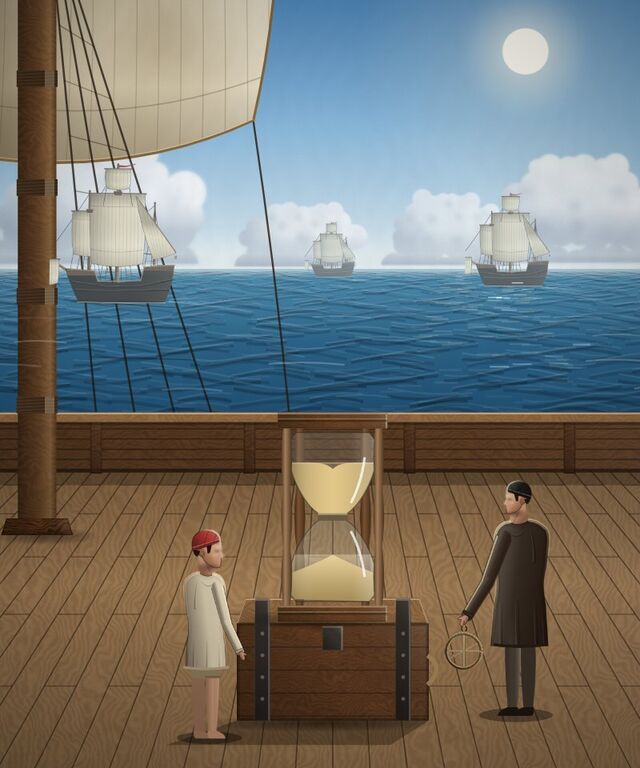
When Magellan's fleet left Spain in September 1519, none of its five ships carried a clock. Time at sea was kept by the ampolleta, a half-hour sandglass, watched over by a ship's boy whose job was to turn it the instant the last grain fell and call out the count.
Eight glasses made a four-hour watch. The system was reset once a day, at true noon, when the sun crossed the meridian and gave everyone a fixed point to check against, the one moment sand couldn't drift from. The rest of the day depended entirely on a boy staying awake and paying attention; a glass turned late, through tiredness or a lapse in concentration, quietly slowed the ship's whole clock.
The fleet's own expense records, still held in the Archive of the Indies in Seville, list exactly what the ships carried for this kind of work: eighteen hourglasses, twenty-one wooden quadrants, seven astrolabes, thirty-five compass needles: the full kit of instruments a sixteenth-century navigator needed to find both a position and a time.
A modern watch never needs anyone to turn it over. Its balance wheel keeps its own beat going, tick after tick, without a tired boy standing watch to remember.