This was the Day of Two Noons, 18 November 1883, when the railroads of the United States and Canada moved their clocks onto standard time. It is often remembered as the day a law gave America its time zones. No law did. Here is a longer look: who drew the zones, why Chicago waited nine and a half minutes, where the signal came from, and how long the law took to catch up.
Fifty railway times
Before 1883, time in America was local. Noon came when the sun stood highest over your own town, and the clocks people trusted, on a church tower or in a jeweller's window, were set by it. Because the Earth turns, that moment arrives about four minutes later for every degree of longitude you travel west. When it was noon in Chicago, it was 12:31 in Pittsburgh and 11:27 in Omaha.
The railroads made the muddle worse. Each line ran on the time of a city it chose, and a station served by several lines might need several clocks. In October 1883 the Chicago Tribune put the number of time standards in railway use at fifty. Wisconsin alone, it is often said, kept 38 local times. That figure turns up in many histories without a source, beside numbers for Illinois, Indiana or Michigan that change from one writer to the next. Take it as a fair picture of the confusion, not a count.
Britain had solved its own version in the 1840s by running its railways on Greenwich time, a story told at Bristol. But Britain spans about 8 degrees of longitude, and the United States some 60. In 1870 Charles F. Dowd, head of a girls' school in Saratoga Springs, New York, proposed four time belts for the railroads. In 1879 the Canadian engineer Sandford Fleming proposed 24 zones around the world, each an hour apart. Fleming found little support at home but more in the United States, where the American Society of Civil Engineers made him chairman of its committee on standard time.
A morning at the Grand Pacific
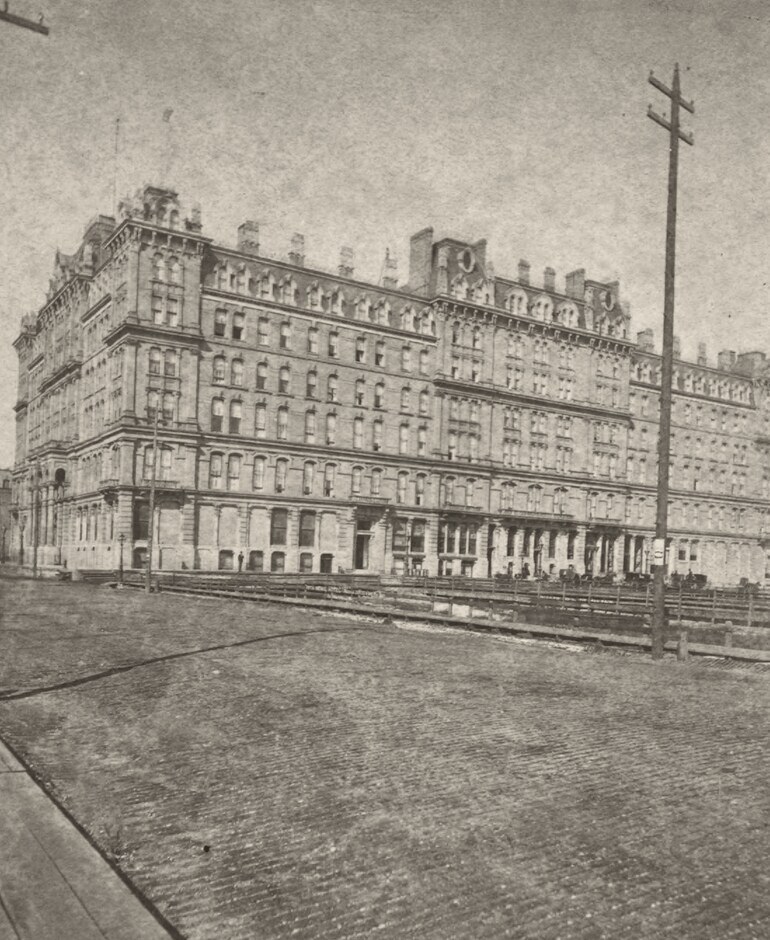
The man who turned the idea into timetables was William F. Allen, secretary of the railroads' General Time Convention and managing editor of their timetable guide, the Travelers' Official Guide. Allen drew up a plan and gathered the companies' votes. On 11 October 1883, at eleven in the morning, the convention met at the Grand Pacific Hotel in Chicago, at LaSalle Street and Jackson Boulevard, where a plaque now marks the meeting. About thirty companies were there, running some 78,000 miles of road. They adopted the plan and fixed Sunday 18 November for the change.
No one from government took part. Congress had been urged to act for years and had not, and the railroad managers feared a government scheme would suit them worse than their own.
Five zones on paper, four in practice
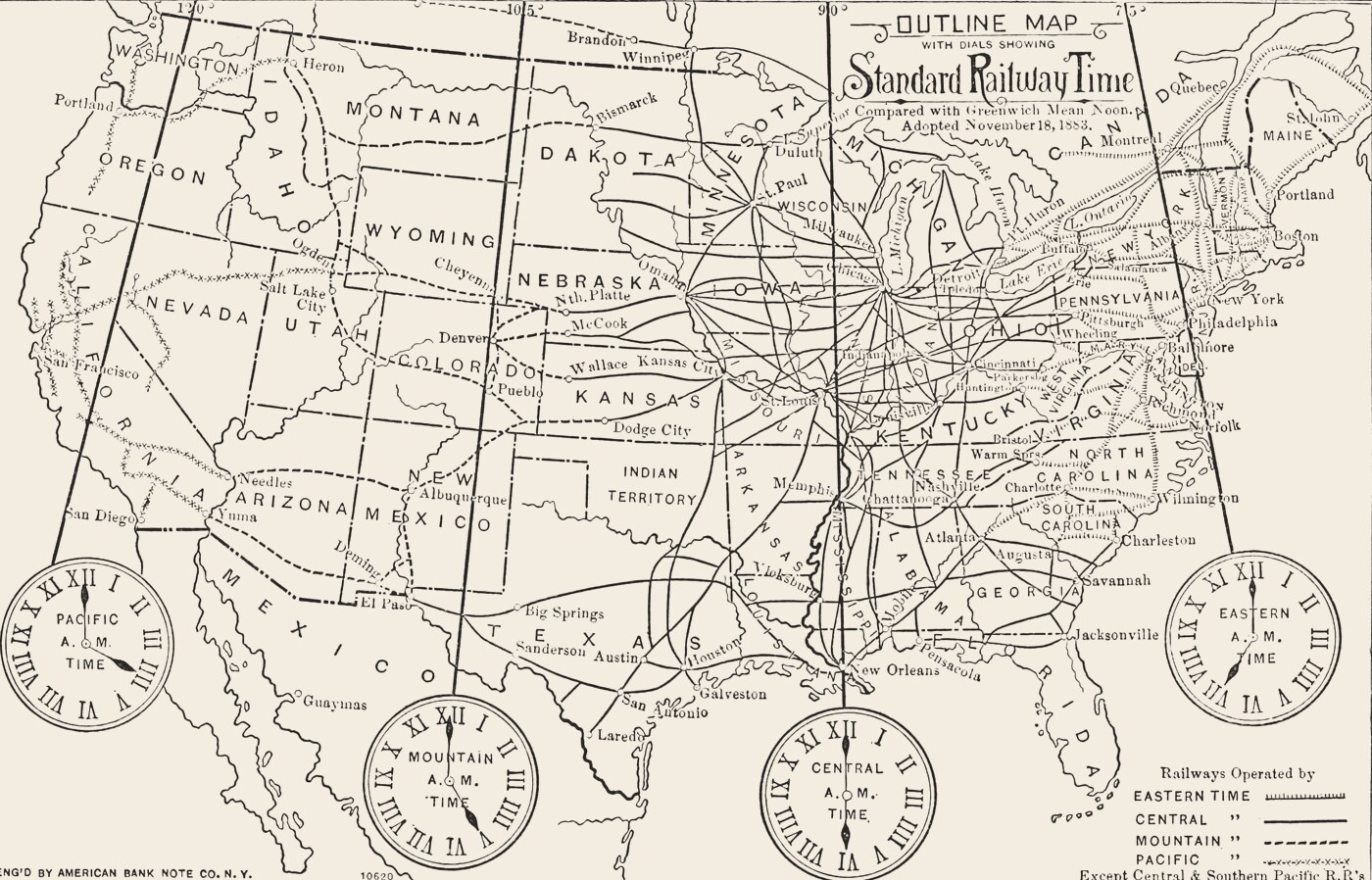
Allen's plan divided the continent by meridians, the north-south lines of longitude counted from Greenwich, 15 degrees apart: one hour of the Earth's turning. Intercolonial time, for Canada's Maritime provinces, belonged to the 60th meridian west, Eastern to the 75th, Central to the 90th, Mountain to the 105th and Pacific to the 120th. Every zone kept the same minutes and seconds, an exact hour from its neighbours. Had the borders followed the meridians strictly, standard time would nowhere have strayed more than half an hour from local time. In practice the railways changed hours at the ends of their lines, at places such as Detroit, Buffalo and Pittsburgh.
So the plan had five zones, the number the Library of Congress gives. How many were used is less clear. Wikipedia, summarising Allen's own history of the change, says the Intercolonial Railway chose Eastern time instead, so the railroads ran on four; an almanac table printed in Science in December 1884 still lists five standards adopted by the railroads, from Nova Scotia to the Pacific. In the United States, at least, there were four, the four on the map at the top of this page.
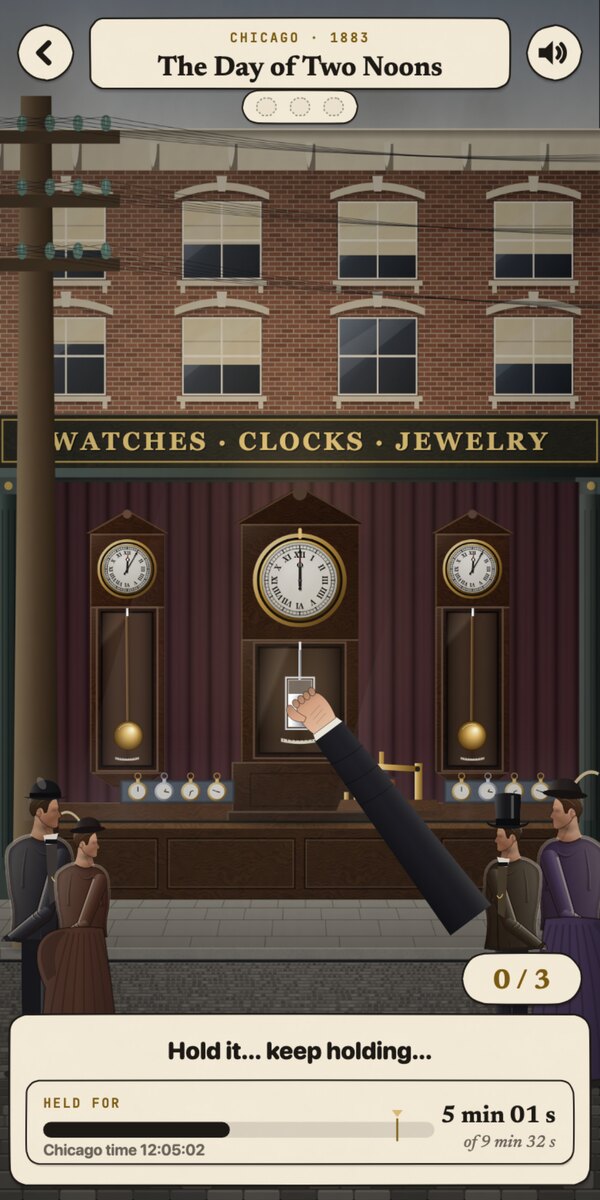
The two noons belonged to the eastern half of each zone. There, local time ran ahead of the zone's meridian, so clocks had to go back, and noon came round a second time. Chicago lies about two and a third degrees east of the 90th meridian, and at four minutes a degree its own time ran nine minutes and thirty-two seconds ahead of Central time. West of a zone's meridian, clocks were put forward instead, and noon came only once. Some railwaymen moved further: lines that had run on Columbus, Ohio, time set their watches back 28 minutes.
Where the signal came from
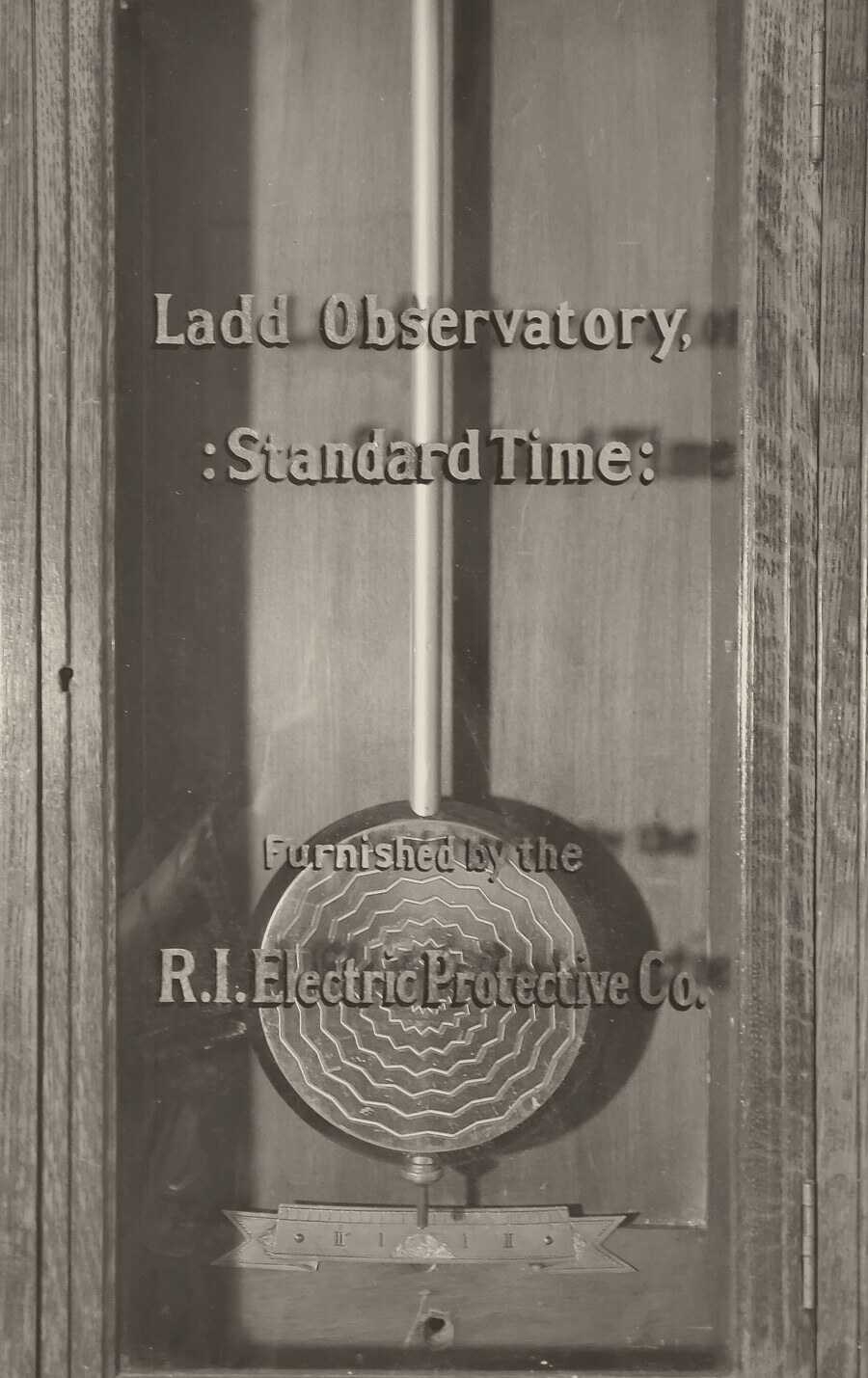
In 1883 exact time was something you bought. Astronomers fixed it by timing stars as they crossed the meridian, kept it on a precise pendulum clock and sent it down telegraph wires to paying customers. A pioneer was Samuel Langley at the Allegheny Observatory, then in the city of Allegheny, which became part of Pittsburgh in 1907. His Allegheny Time System began in 1869, with the Pennsylvania Railroad as its first railway subscriber, and by 1883 reached cities and railroads over more than 4,700 miles of telegraph.
Chicago had its own observatory too. In 1881 the Inter Ocean reported that the city took its time from two centres, the Allegheny Observatory and Chicago's Dearborn Observatory, and that the Allegheny time was the more trusted. On the day itself, the Tribune is specific. The depot's telegraph instruments were connected to the pendulum of the observatory clock at Allegheny, from which the Fort Wayne and Pan-Handle lines took their time. The lines that did not take it directly got their time from local jewellers, chiefly Potter and the Western Electric company, who took theirs from Allegheny as well. For Chicago, then, the familiar story holds: the signal came from Allegheny.
What does not hold is the wider claim that a single signal from Allegheny, sent at noon on the 90th meridian, reset every railway clock on the continent. Other observatories sent time too. The Naval Observatory in Washington telegraphed the new time to its subscribers, the railways into Boston depended on Harvard's observatory, and the Library of Congress names the Naval Observatory and Allegheny together. Wikipedia's article on standard time even gives both versions: Allegheny at noon on the 90th meridian in one paragraph, the observatories at noon Eastern time in the next. In the Tribune's Chicago, the beats from Allegheny stopped at noon Central time.
Set back nine minutes
Out in the city, the change was quieter. At noon the Western Electric Manufacturing Company, whose wires carried time to the main jewellers' shops and most of the railway depots, turned its clocks back nine minutes. "All of the leading jewelers had men in their places to make this change," the Tribune reported, and cards reading "The New Central Time" went up in the window chronometers. Some jewellers just put up a card saying "Set back nine minutes." From noon on, small groups stood at the windows setting their watches, and the greeting on the street was "Have you the new time?"
Not everyone moved at once. Three of the railroads centred on Chicago, the North Western, the Milwaukee and St. Paul and the Illinois Central, planned to change the following Sunday, and the Michigan Central, which ran on Detroit time, had not yet decided. Sources differ on how fast the city followed. The Chicago Public Library dates the city's own adoption to the next day, 19 November; a 1983 history in American Heritage says the city fathers were not ready, and that some working people feared the nine minutes might somehow lengthen their day.
Thirty-five years without a law
None of this was law. Railroad time ran the trains, and everyone else could follow it or not. In Washington the Attorney General, Benjamin Brewster, ruled that government clocks could not change without Congress; the superintendent of the Naval Observatory sent out the railroad time regardless. The Signal Service, which ran the country's weather observations, told its observers to stay on the local time of their stations.
Resistance had a moral edge. Opponents spoke of "God's time", and the Indianapolis Sentinel grumbled that "The Sun is no longer to boss the job." In Bangor, Maine, Mayor Frederick Cummings vetoed standard time twice, calling local noon "one of the immutable laws of God", and two of the city's four public clocks stayed 25 minutes ahead of the rest of the state until Maine adopted Eastern time for every town in 1887. Detroit, on the seam between Eastern and Central, argued about its clocks for decades and settled on Eastern time only in 1915.
The world, meanwhile, settled a larger question. In October 1884 the International Meridian Conference in Washington, with Fleming among the British delegates, voted 21 to 1, with two abstentions, for Greenwich as the starting line of longitude: the story of the next stop. It did not adopt Fleming's world zones, though most countries made similar ones within about forty years.
Congress caught up only in wartime. The Standard Time Act, approved on 19 March 1918, divided the country into five zones, the fifth for Alaska, gave the Interstate Commerce Commission the job of fixing their limits, and in the same act brought in daylight saving time. The daylight saving part was repealed in 1919 over President Wilson's veto; the zones stayed. Today moving a county from one zone to another is a matter for the Department of Transportation. Between the railroads' noon and the law's, thirty-five years had passed.
An hour at a time
The zones the railroads drew that day are essentially the ones still crossed on road trips and flights. The borders have wandered, county by county, but each zone still sits a whole number of hours from Greenwich, so crossing into the next one moves the hour hand and leaves the minutes alone. Before 1883, a salesman going from Boston to St. Louis had to set his watch back one hour, sixteen minutes and forty-six seconds.
How railway watches were made to keep that time is a story for Kipton, Ohio, and watches with a second hour hand for a second zone come later in this tour. Setting your watch forward or back an hour at a state line is a small, everyday echo of that Sunday in 1883, when a room of railwaymen held the clock at noon and waited for the wire.